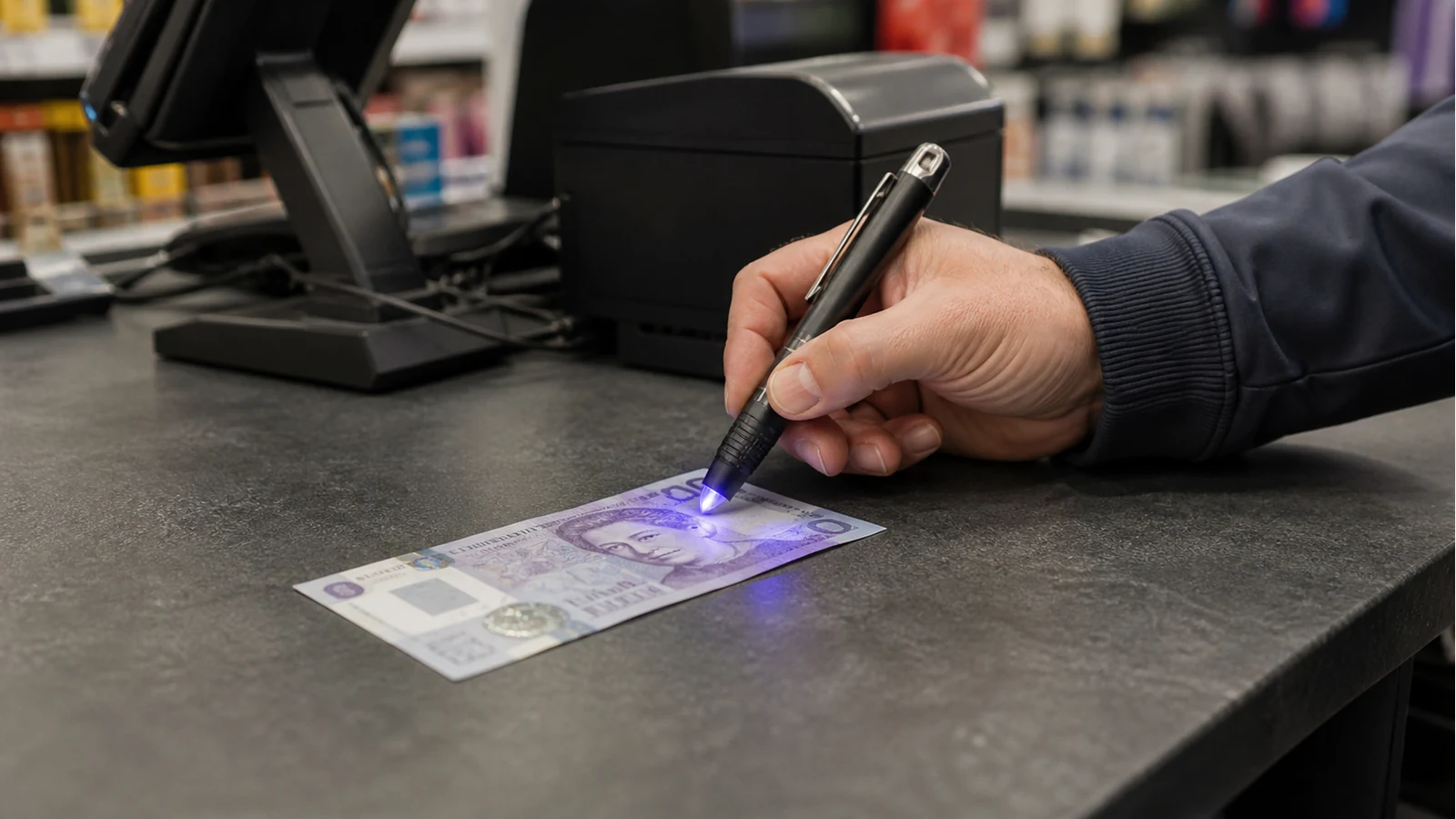
How To Use A Uv Counterfeit Detector Pen Uk
A UV counterfeit detector pen is useful when it is part of a routine, not when it is treated as a magic wand. In the UK, start with the normal look, feel and tilt checks, then use UV to confirm that the expected fluorescent feature appears in the right place. The Bank of England says a UV lamp around 365 nm is ideal for checking fluorescent features, and its £20 guide says the UV number should appear bright red and green under good quality UV light.
The practical decision is simple: check the note before it enters the till, slow down only for higher-value or suspicious notes, and stop if the result conflicts with the physical features. If the customer has gone and the note later looks suspect, the Bank of England counterfeit-note guidance says counterfeit notes are worthless and not reimbursed, so the next step is reporting and evidence handling rather than trying to spend it.
Quick Decision
Use a UV pen when you need a fast till-side check on a current polymer note, but do not skip the physical features. A genuine-looking UV response is reassuring only when the note also feels like polymer, has sharp print, has the right window and behaves normally when tilted. If one check is odd, slow down. If two checks are odd, do not accept the note.
Diagnostic Ladder
| Step | What to do | Proceed when | Stop when |
|---|---|---|---|
| 1. Look | Check print quality, window and general condition. | The note looks sharp and complete. | Print is blurred, window looks wrong or the note seems altered. |
| 2. Feel | Check polymer feel and raised print. | The note feels like thin flexible plastic with raised areas. | It feels papery, waxy, limp or unusually smooth. |
| 3. Tilt | Check the visible security features move as expected. | The visible features behave consistently. | The note has flat or lifeless features. |
| 4. Light | Use UV on the expected number area. | The expected UV feature appears and other checks passed. | The UV response is absent, misplaced or the earlier checks already failed. |
Where to Shine the UV Light
On a current £20 note, use the UV light on the front of the note where the ultraviolet number appears. The Bank of England £20 note guide describes the number 20 appearing in bright red and green under good quality UV light. Do not use a random glow anywhere on the note as your test; counterfeit materials, paper, clothing lint and till surfaces can all fluoresce in ways that distract from the official feature.
Negative Fit
- Do not buy a portable UV pen if you need automated counting, sorting or audit records for large cash volumes.
- Do not rely on UV alone for Scottish or Northern Ireland notes unless you have checked the relevant issuing-bank guidance.
- Do not use any detector to justify a confrontation when the safer option is to refuse politely or call a manager.
Stop Conditions
Stop accepting the note if the customer is still present and the note fails the routine. The Ask the Police advice says a shop owner or employee who knows or suspects who passed a forged note should preserve it and hand it to police. If the customer has already left, separate the note, record the time and till, keep CCTV if available, and follow your local reporting process.
When a Portable UV Pen Fits
A portable pen is relevant when you handle occasional £20 or £50 notes and need a quick light check at the counter, stall or doorway. In that case, a same-site option such as the portable UV detector pen can be considered after you have decided that a hand tool, rather than a counter-top machine, matches the job.
How to Use This at the Point of Decision
The useful habit is to decide before the pressure starts. Write down which notes trigger a check, where the check happens, who has authority to refuse, and what alternative payment you will accept. That turns the moment from a personal judgement about a customer into a normal cash-handling rule. It also protects staff and volunteers because they are following a policy rather than improvising.
Keep the routine short enough that it survives a queue. If the note passes the visible checks and the light check, proceed normally. If the note is merely awkward to judge, ask for another payment method or call a manager. If the note fails clearly, do not give change, release goods or complete handover. If the person has already left, separate the note, write down the transaction context and follow the reporting route. The point is not to win an argument; it is to avoid turning one doubtful note into a larger loss.
Reader Questions Answered
What should I check before I switch on a UV pen? Start with the visible and tactile checks, then use UV only as the final confirmation step.
Where should I shine the UV light on a £20 note? Make the decision before the note goes into the till, cash tin, wallet or vehicle-sale envelope.
How do I avoid treating UV as a guaranteed pass? If the setting makes checking unreliable, change the setting, ask for another payment method or pause the sale.
What should I do if the note looks wrong but the customer is still there? If the customer is present, keep the language procedural: say that larger notes are checked as standard.
When is a portable UV pen the wrong tool? If the tool does not match the volume, lighting or safety risk, choose training, a fixed machine, bank transfer or manager escalation instead.
What is the next step if I already accepted the note? Stop when checks fail, pressure begins, or you cannot complete the check safely and calmly.
Record the Rule So It Survives the Shift
A cash check is weakest when it lives only in one person’s head. Put the trigger rule in the till note, staff handbook, market kit list or sale checklist. For example: check larger notes before giving change; call a manager when one feature fails; use another payment method when the setting is too rushed; record the time and context if a suspect note is found later. That small written rule makes the behaviour repeatable for part-time staff, volunteers, family helpers and tired end-of-shift teams.
FAQ
Is this legal advice? No. This is a practical cash-handling guide based on public UK guidance. For suspected counterfeit notes, follow police and Bank of England instructions.
Should I check every note? Most small businesses set a trigger for higher-value notes and anything that feels wrong. High-volume sites may need stronger controls.
Can a genuine note fail one check? A worn or damaged genuine note can look imperfect, which is why you should avoid one-factor decisions and escalate rather than argue.
When this check is not enough
Do not use a UV light, detector pen or small checking device as standalone proof that a Bank of England note is genuine.
When to stop and follow official guidance
Stop and follow official counterfeit-note handling guidance when a note remains suspicious, staff feel unsafe, the customer becomes confrontational, or the decision could become a legal or police matter.